15 Reasons Drupal Is a Strong Choice for Secure Websites
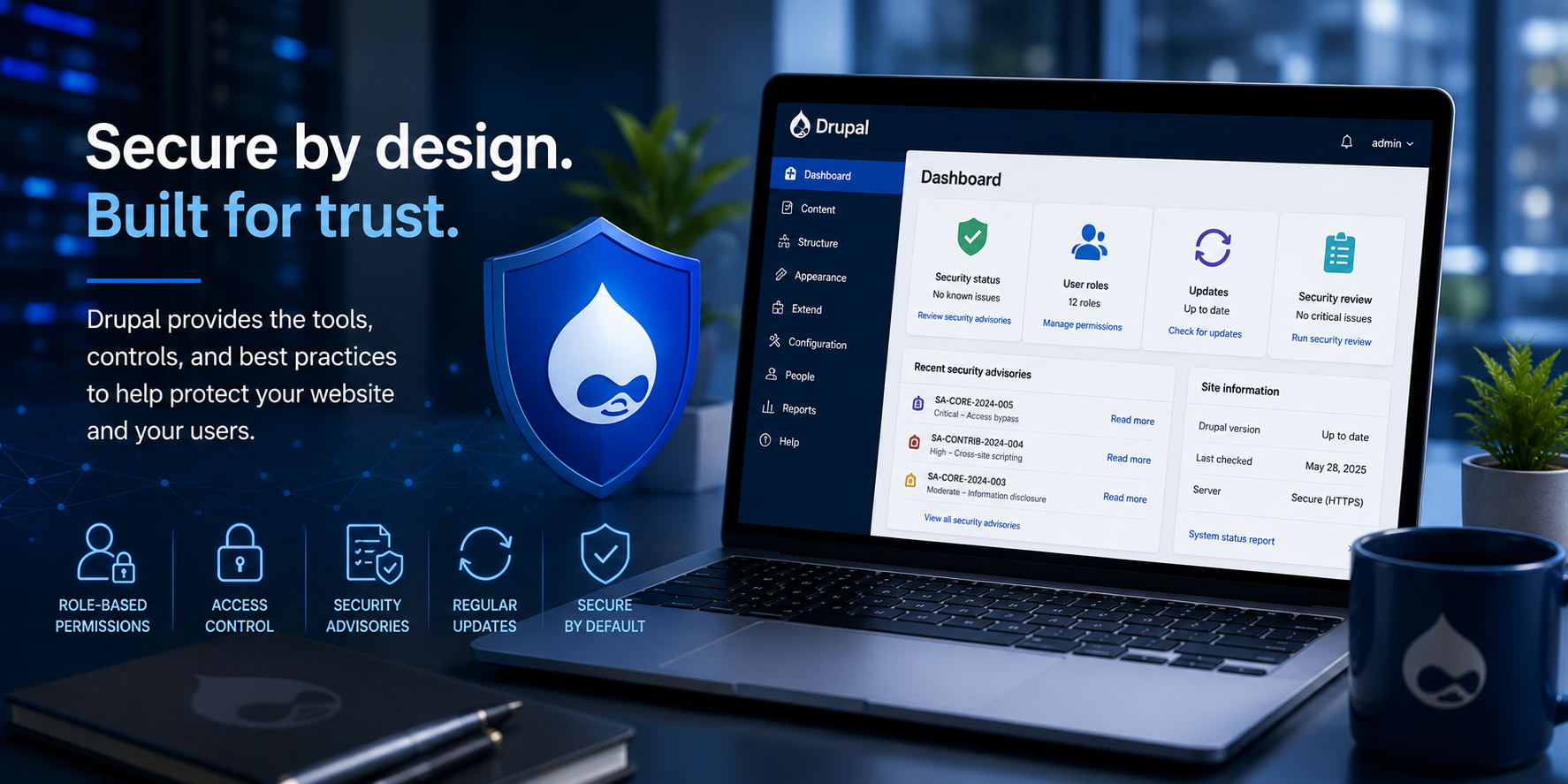
Why Drupal Is a Strong Choice for Secure Websites
Editor’s note: This article was originally written for Drupal 8. The concepts remain relevant to modern Drupal, but some version-specific details have changed.
Drupal has long had a strong reputation for security, especially for larger organizations, government websites, universities, associations, and other sites where access control, publishing workflows, and long-term maintenance really matter. We'll list fifteen reasons why Drupal is a strong choice for secure websites, but most of them may not mean much to non-developers, so we'll just touch on each reason at a high level.
1: Drupal Core Includes More Crucial Built-in Functionality
This is crucial to website security because core modules have a much higher level of scrutiny than many community contributed modules do. Being in core means passing a stricter review process before being added, and with many more eyeballs on the code. Also, unlike some contributed modules, Drupal core updates are released on a predictable basis.
What is a module? Drupal modules provide plug-and-play features and functionality. Typically, you can enable and configure them to make their feature or function available. Drupal includes core modules that ship with Drupal, and contributed modules are added and maintained by the Drupal community.
2: Drupal Has a Dedicated Security Team and Advisory Process
Drupal has a dedicated security process for reviewing reported security issues and publishing advisories when site owners need to take action. This does not mean you can ignore updates, but it does mean Drupal has a mature process for identifying, coordinating, and communicating security fixes.
3: Drupal Is Built on a Modern PHP Architecture
Modern Drupal uses widely adopted PHP components and practices rather than relying only on older Drupal-specific architecture. That matters because more developers, maintainers, and security researchers are familiar with the underlying patterns. More eyes on the code and more standard practices generally mean fewer places for security problems to hide.
4: Twig Templates Enforce Better Separation and Safer Output
Twig provides much stricter separation between business logic and presentation. For example, you should not be running SQL queries or arbitrary PHP code from a Twig template. Drupal also uses Twig auto-escaping, so strings printed in templates are escaped by default unless they are intentionally marked safe.
5: PHP Input Is No Longer Part of Normal Site Building
Older Drupal sites could use the PHP input filter to add PHP directly to blocks, pages, or other content areas. That was always considered dangerous, and it is not part of a normal modern Drupal site-building workflow. This removes one of the easiest ways for a misconfigured editor account to become a serious security risk.
6: Configuration Is Managed Separately from Executable Code
Modern Drupal stores site configuration in a structured configuration system instead of asking site builders to place settings and site-building changes directly into PHP. This makes configuration easier to review, compare, export, test, and deploy. It is also much safer than making one-off changes directly on a live production site.
7: Improved Editor Content Entry and Text Filtering
Drupal provides text formats and filters to control how user-entered HTML is processed before it is displayed. This is very important for reducing Cross-site Scripting (XSS) risk, especially on sites where editors, members, or other users can create formatted content. Full HTML should be reserved for highly trusted users, while more restrictive formats should be used for most editorial roles.
8: Role-Based Permissions Are Granular
Drupal's role and permission system is one of its biggest strengths. You can create different roles for content editors, reviewers, site builders, administrators, and other groups, then give each role only the permissions it actually needs. That helps reduce the risk of giving too much power to the wrong account.
This also supports the principle of least privilege. In plain English, users should only have the access they actually need. A content editor may need permission to create and edit pages, while a reviewer may need permission to approve content, and a site administrator may need broader configuration access. Keeping those roles separate helps reduce risk if an account is misused or compromised.
9: Content Moderation Helps Prevent Accidental Publishing
Security is not just about hackers. It is also about controlling who can publish, when content becomes visible, and whether important changes have been reviewed. Drupal Workflows and Content Moderation can support review states like draft, needs review, approved, and published, helping teams avoid accidental or unauthorized publishing.
10: Cross-site Request Forgery Protection Is Built into Routes and Forms
Cross-site Request Forgery (CSRF) tricks a logged-in user into performing an action they did not intend to perform. Drupal includes CSRF protection patterns for forms and protected routes, which helps developers avoid forgetting these checks when building features that change site data.
11: Trusted Host Settings Help Prevent Host Header Attacks
Trusted host settings help prevent Drupal from responding as though it belongs to a fake or unexpected domain name. This matters because host header spoofing can lead to bogus password reset links, misleading emails, and other security-related problems if a site is not configured correctly.
12: Drupal's Database API Encourages Safer Database Access
Drupal's database abstraction layer gives developers a standard way to work with database queries. When developers use Drupal's APIs correctly, they are less likely to write unsafe database code by hand. This helps reduce the risk of common problems such as SQL injection.
13: Clickjacking and Browser Security Headers Are Better Supported
Modern Drupal sites can use browser security headers to help defend against attacks such as clickjacking and certain types of injected content. Newer Drupal versions also continue to improve support for Content Security Policy (CSP), which allows a site to tell browsers which sources are trusted for page resources.
14: Security Review Tools Can Catch Common Configuration Mistakes
The Drupal ecosystem includes tools such as the Security Review module, which can check for many easy-to-make mistakes that may leave a site insecure. A tool like this does not magically secure a website by itself, but it can help site owners find configuration issues before they become bigger problems.
15: Drupal Rewards a Mature Maintenance Process
A secure website is not something you launch once and forget. Drupal's security advisory process, update culture, configuration management, and Composer-based dependency workflows all support a more mature maintenance process. If your team applies updates, reviews configuration, limits permissions, and monitors advisories, Drupal gives you a strong foundation to build on.
Optional added protection: Organizations with higher-risk Drupal sites may also consider services such as Drupal Steward, a paid protection service associated with the Drupal Association ecosystem. Services like this do not replace timely updates, but they can add an extra layer of protection during critical security release windows.
Conclusion
There are far more than twelve reasons Drupal is a strong choice for secure websites. Some of the original Drupal 8 improvements have now become standard expectations in modern Drupal, and the platform has continued to mature around security, configuration management, editorial workflows, and maintainability.
That said, Drupal is not magically secure just because it is Drupal. You still need good hosting, timely updates, proper permissions, safe custom code, sensible text formats, secure configuration, and a maintenance plan.
If security is a concern to your organization, Drupal remains one of the strongest CMS platforms to consider for serious, long-term website projects.