How Drupal Supports Personalized Content and Flexible Digital Experiences
Drupal Helps Future-Proof Your Website
Editor’s note: This article was originally written for Drupal 8. The concepts remain relevant to modern Drupal, but some version-specific details have changed.
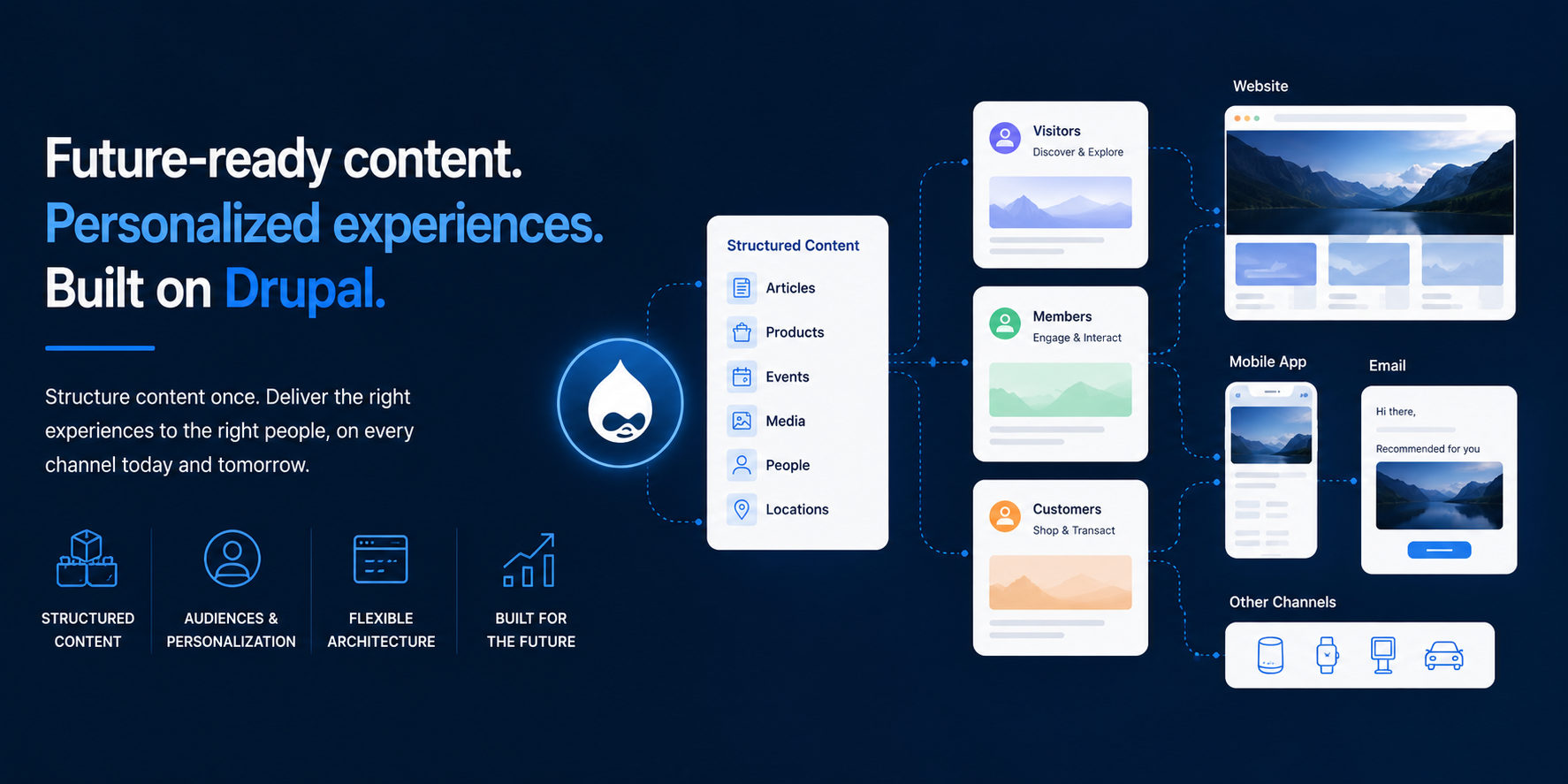
Drupal can help future-proof your website in several important ways:
- It supports a more predictable upgrade path than older major-version rebuild cycles.
- It makes your content more structured and reusable.
- It allows your content to be used beyond a traditional website page.
- It gives site builders a strong foundation for personalized and flexible digital experiences.
We’ll explore each item further below.
Modern Drupal Makes Long-Term Upgrades More Manageable
The biggest hesitation we’ve seen with major Drupal upgrades is cost and effort. Older Drupal migrations could feel like rebuilding the website from the ground up. That was a real concern for organizations trying to plan budgets and avoid disruption.
Think of a migration as a major website move where content, media, users, configuration, and other important pieces are moved into a new Drupal build. The words upgrade and migration are often used together, especially when moving from much older Drupal versions.
Modern Drupal is designed around a more continuous upgrade path. That does not mean complex sites upgrade themselves, but it does mean the platform has moved away from the old pattern where every major version felt like a completely separate product.
Complex websites still require planning, testing, code review, and content validation. But a well-maintained Drupal site gives your organization a stronger foundation for ongoing updates, security releases, new features, and future redesign work.
Future-Proof Your Content with Drupal
Personalized content helps create a better customer journey and web experience. A simple example would be welcoming a returning visitor by name, showing content related to a visitor’s interests, or displaying different calls to action based on audience type.
The key to personalization is not just adding a personalization tool. The foundation is structured content. Drupal allows site builders to define content types, fields, taxonomy, media, users, roles, and reusable components so content can be organized and reused in smarter ways.
Step 1: Make Drupal Content Easier to Understand and Reuse
Drupal does an excellent job of making content structured and reusable. Instead of treating every page as one large blob of text, Drupal lets you define meaningful fields, relationships, categories, and metadata.
This helps search engines, internal site search, content listings, related content blocks, personalization tools, and external systems better understand what the content is and how it should be used.
Metadata also matters. Drupal can be extended with tools such as the Metatag module and Schema.org-related tools to provide richer information for search engines, social platforms, and other systems that consume website content.
Step 2: Share Drupal Content Beyond Browsers and Screens
It can be a bit mind-boggling when you stop to think about all the ways content gets consumed today. Content may appear on a website, in a mobile app, in an email campaign, in a search result, in a social preview, in a voice-assisted experience, or inside another connected system.
Drupal is well suited for this because it can act as both a traditional CMS and a structured content platform. Drupal’s API capabilities make it possible to share content with decoupled front ends, mobile apps, third-party services, and other digital channels.
We will cover Drupal’s JSON:API capabilities in more detail in a separate article, but the short version is this: when content is modeled well in Drupal, it can be reused outside the traditional website. That makes it possible to deliver the same structured content to mobile apps, decoupled front ends, third-party platforms, and future digital channels without rebuilding the content model from scratch.
In plain English: create the content once, structure it well, and Drupal can help you reuse it in more places.
Search and Content Discovery Depend on Structure
Future-ready content is not only about APIs and personalization. It also helps people find what they need. Drupal’s structured content, fields, taxonomy, metadata, and Views-powered listings can all improve content discovery across a website.
A strong search strategy starts with well-organized content. When content is tagged consistently, modeled clearly, and displayed through intentional listings, the site can support better filtering, related content, landing pages, search results, and personalized recommendations.
Step 3: Support Personalized Customer Journeys
Drupal gives you the content foundation needed for personalization: structured content, taxonomy, reusable media, user roles, permissions, APIs, and flexible display options.
For organizations that need more advanced personalization, paid tools can be added on top of Drupal. For example, Acquia’s product ecosystem includes tools for personalization, campaign journeys, experimentation, and customer experience optimization. These tools do not replace Drupal’s structured content foundation; they build on top of it.
Optional paid enhancement: Drupal can provide the structured content and architecture, while paid platforms such as Acquia Convert or Acquia Campaign Studio can help teams create more advanced personalization, testing, and customer journey experiences.
Future-Proofing Through Drupal’s Release Cycle and Architecture
One of the key reasons for Drupal’s success is that the platform continues to make forward-looking changes. In the past, major version upgrades could be painful. Modern Drupal has moved toward a more predictable release process and a better long-term maintenance model.
This matters because websites are not static projects anymore. Your organization may need new integrations, new content models, new accessibility improvements, new performance standards, new marketing tools, new personalization features, or new design patterns over time.
Drupal’s architecture is flexible enough to support that kind of change. Structured content, fields, entities, taxonomy, media, blocks, Layout Builder, Workflows, Workspaces, multilingual tools, and APIs all contribute to a platform that can grow with your needs.
Conclusion
Drupal helps future-proof websites by making content more structured, reusable, and ready for multiple channels. It supports modern upgrade practices, flexible architecture, APIs, metadata, and the kind of content modeling needed for personalization and digital experience platforms.
The real power is not just that Drupal can publish pages. The power is that Drupal can help your organization manage content as reusable, structured information that can support websites, apps, integrations, campaigns, search, personalization, and future digital channels.
If your organization wants a website platform that can grow with changing content, marketing, accessibility, and integration needs, Drupal remains a strong foundation to build on.