Using Drupal JSON to Share Structured Content Across Websites, Apps, and Integrations
Introducing Drupal JSON:API
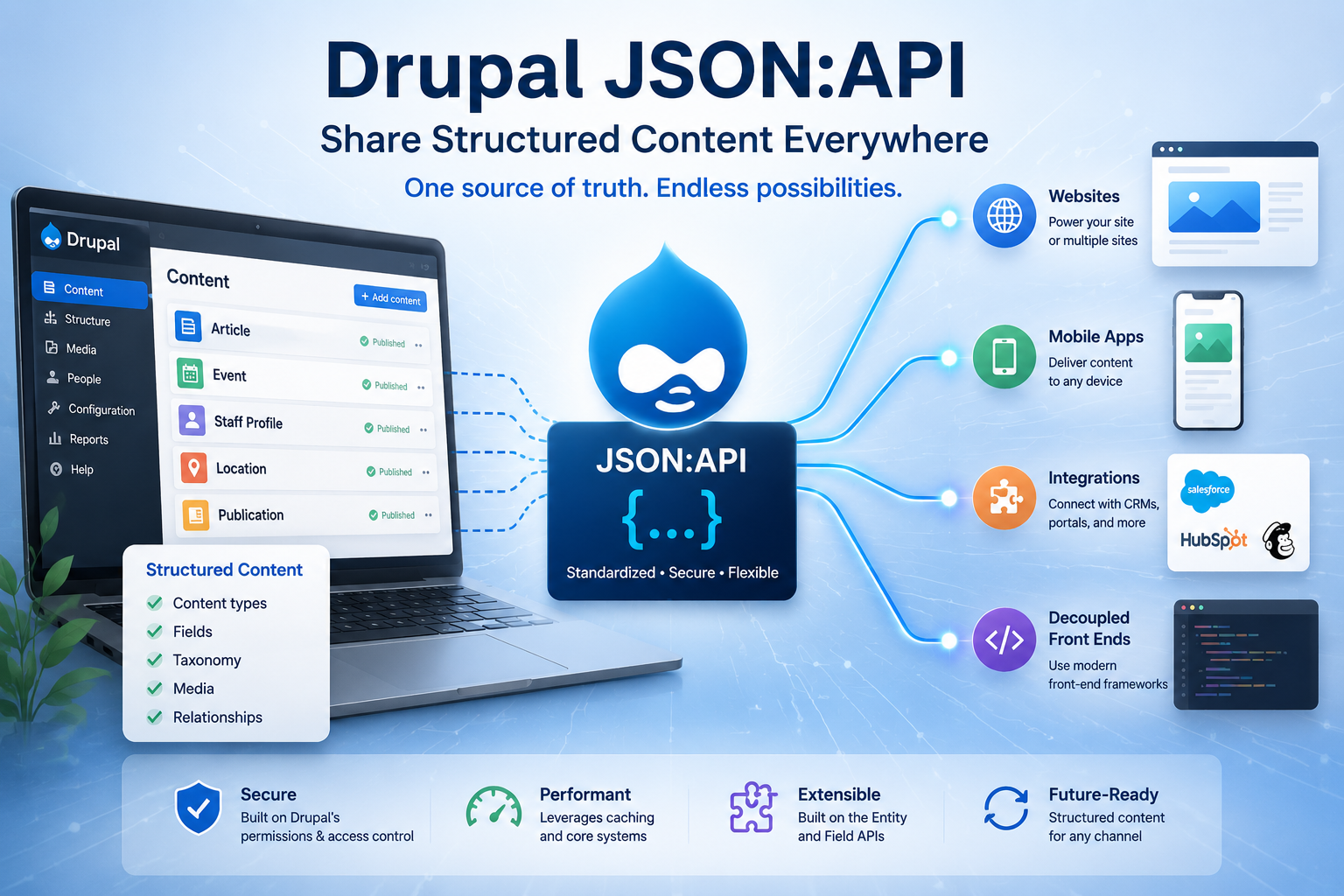
Drupal is not only a website content management system. It can also act as a structured content platform that shares content with other websites, mobile apps, decoupled front ends, and third-party systems.
The JSON:API module is one of the most important tools for that kind of architecture. It gives developers a standardized way to request Drupal content as JSON, using predictable API paths based on Drupal entity types and bundles.
In plain English: if your Drupal content is modeled well, JSON:API can make that content easier to reuse outside the normal Drupal page display.
Why JSON:API Matters
Modern organizations often need content to show up in more than one place. A news article might appear on the main website, a mobile app, an email campaign, an internal dashboard, and a partner portal. A product, event, staff profile, location, or publication might need the same kind of flexibility.
Without an API-first approach, teams may end up copying and pasting the same content into multiple systems. That creates extra work, inconsistent content, and more places where old information can live.
JSON:API helps solve that problem by letting other systems request structured Drupal content directly.
JSON:API Builds on Drupal’s Structured Content
JSON:API becomes most powerful when Drupal content is structured clearly. Content types, fields, media, taxonomy terms, users, and relationships all matter.
For example, a Drupal event might have fields for title, date, location, speaker, registration link, image, summary, and topic. Instead of treating that event as one large block of text, Drupal stores each piece of information in a structured way.
JSON:API can then expose that structured content so another application can decide how to display it.
Example JSON:API Use Cases
JSON:API can support many kinds of modern digital projects, including:
- Decoupled front ends that use Drupal as the content source.
- Mobile apps that display Drupal-managed content.
- Microsites that reuse content from a central Drupal site.
- Internal dashboards that pull content, events, or publications from Drupal.
- Partner integrations where approved content needs to be shared externally.
- Future digital channels that need reliable structured content.
What Does a JSON:API Endpoint Look Like?
JSON:API paths are based on Drupal entity types and bundles. For example, a content type can have an API path that exposes published content in a structured JSON format.
A demo endpoint might look similar to this:
/jsonapi/node/articleThe exact endpoint depends on the entity type and bundle being requested. A site may expose different paths for articles, pages, media items, taxonomy terms, users, or other entity types depending on the site’s configuration and access permissions.
JSON output is not meant to look like a finished web page. It is meant to give developers structured data that another application can consume and display.
Access Control Still Matters
JSON:API does not mean everything on the site should be public. Drupal’s permission and access systems still matter. If a user or anonymous visitor does not have access to view something in Drupal, that access decision should also matter when content is requested through an API.
This is one reason Drupal works well for API-driven projects. It combines structured content with familiar Drupal access control, authentication, caching, and entity relationships.
JSON:API and Future-Proof Content
JSON:API fits naturally with Drupal’s future-proofing story. If your content is structured well today, it is easier to reuse tomorrow.
A website redesign, mobile app, external integration, or new frontend framework should not require rebuilding the entire content model from scratch. Drupal can remain the source of truth while different systems consume and display the content in different ways.
That is the real benefit: create and manage content in Drupal, then deliver it where it needs to go.
Conclusion
Drupal JSON:API gives developers a standardized way to share structured Drupal content with other websites, apps, front ends, and integrations. It is especially useful for organizations that want Drupal to serve as both a traditional CMS and a flexible content platform.
For teams thinking beyond a single website, JSON:API is one of the clearest examples of why structured Drupal content matters.