How Drupal Entities Create Flexible, Structured Content
Introduction to Drupal Entities and Structured Content
Editor’s note: This article was originally written for Drupal 8. The concepts remain relevant to modern Drupal, but some version-specific details have changed.
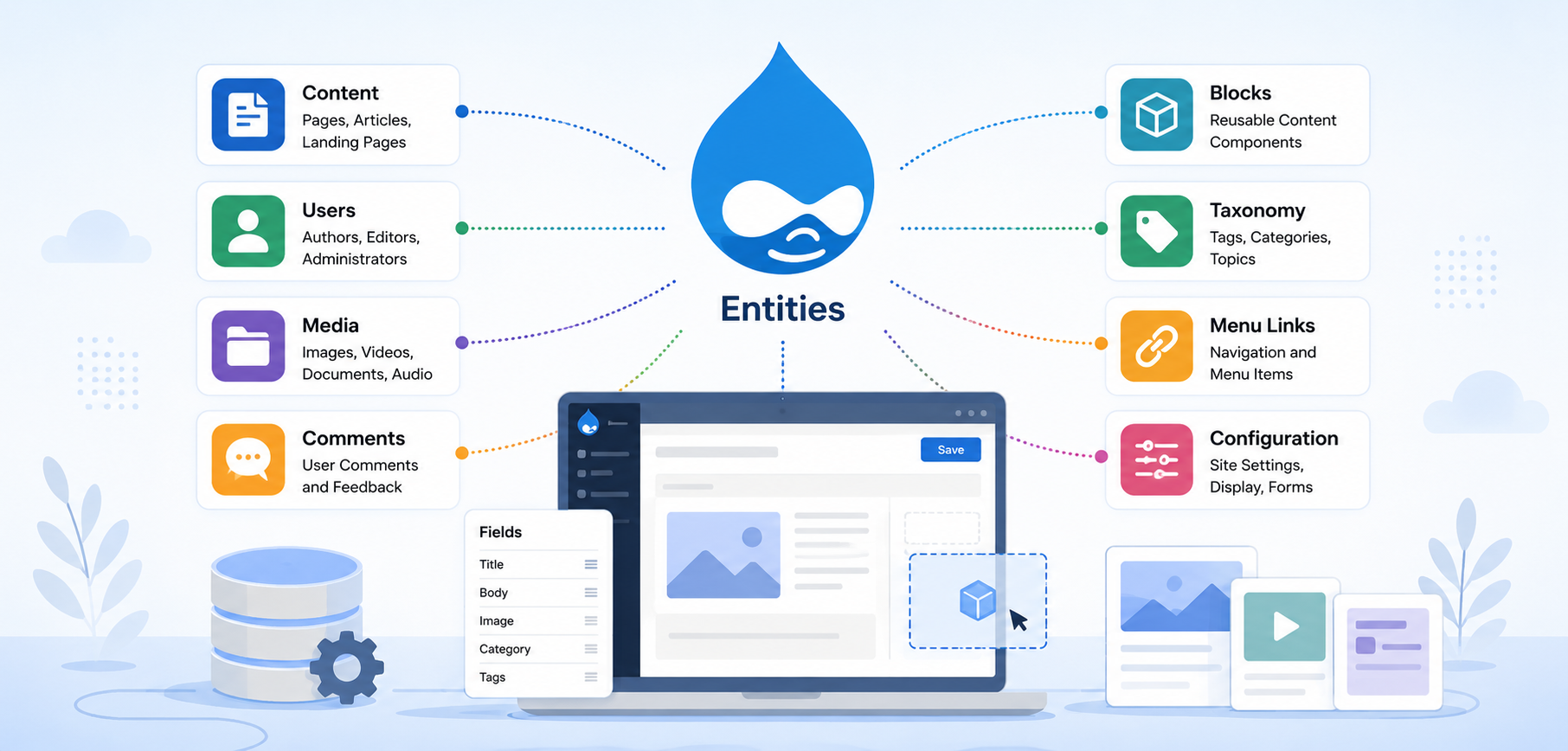
Drupal entities are one of the core architectural concepts that make Drupal flexible. An entity is a structured object used to store and manage content or configuration information. Pages, users, taxonomy terms, media items, comments, menu links, blocks, and configuration objects can all be represented through Drupal’s entity system.
This architecture gives site builders a consistent way to model content and relationships. For example, a page can reference media, taxonomy terms, users, or reusable blocks. Those references make it possible to build flexible content structures without duplicating the same information in multiple places.
The entity system also creates a more consistent experience for adding, editing, displaying, translating, and managing site information. Once a site builder understands how entities, bundles, and fields work together, Drupal becomes much easier to model around real business needs.
Content Entities and Configuration Entities
Drupal entities generally fall into two major categories: content entities and configuration entities.
Content entities store user-facing information that editors and site users create or manage through the website. Common content entities include:
- Content items such as pages, articles, or other content types
- Media items such as images, documents, audio, and video
- Taxonomy terms such as tags, categories, and topics
- User accounts
- Comments
- Custom blocks
- Files
- Menu links
Configuration entities store site-building information that controls how the site behaves, such as user roles, menus, image styles, view displays, field settings, and other configuration that can be exported and deployed between environments.
Example Use Case: Reusable Blocks
Let’s tie this together with a practical example.
Suppose you wanted to create reusable promotional blocks for several different campaigns on your site. Traditionally, reusable blocks were often limited to sidebars, headers, footers, or other pre-designated theme regions.
What is a Drupal theme? A theme controls the look and feel of a Drupal website. Themes include templates, HTML structure, CSS, JavaScript, media assets, and other frontend resources that determine how content is presented to visitors.
With Drupal’s entity and field system, reusable content can become much more flexible. A site builder can create structured block types, add fields to those blocks, and allow editors to place or reference them in different contexts.
For example, a promotional block could include a title, image, summary, call-to-action link, and category field. Editors could reuse that block across pages, place it through Layout Builder, or reference it from other content where appropriate.
The same idea applies to taxonomy and media. If a page and a reusable promotional block share the same taxonomy term, a site builder could create a dynamic display that shows related promotional blocks based on the topic of the current page.
Entities Also Power Views, Taxonomy, and Reusable Blocks
Drupal’s entity system becomes especially powerful when combined with Views, Taxonomy, and reusable blocks. Views can create dynamic lists, tables, feeds, and blocks from structured content. Taxonomy can organize content by topic, audience, category, or department. Reusable blocks can place structured promotional content, calls to action, or supporting information across the site.
Because these tools all build on Drupal’s structured content foundation, site builders can create flexible displays and relationships without hard-coding every page by hand.
Why Entities Matter
Drupal entities make it possible to build structured, reusable, and connected content models. Instead of treating every page as a single blob of text, Drupal lets site builders define meaningful pieces of information and relationships between them.
This is why Drupal works well for complex websites, intranets, government portals, higher education sites, publishing platforms, and other projects where content needs to be organized, reused, filtered, translated, or governed.
Conclusion
Drupal entities provide the foundation for structured content and flexible site architecture. They allow content, media, users, taxonomy, blocks, menu links, and configuration to be managed in consistent ways.
For editors, this can create a more predictable authoring experience. For site builders, it provides a powerful framework for modeling real-world content relationships and building reusable features across a website.