Drupal Recipes and the Future of Faster Site Building
Introducing Drupal Recipes
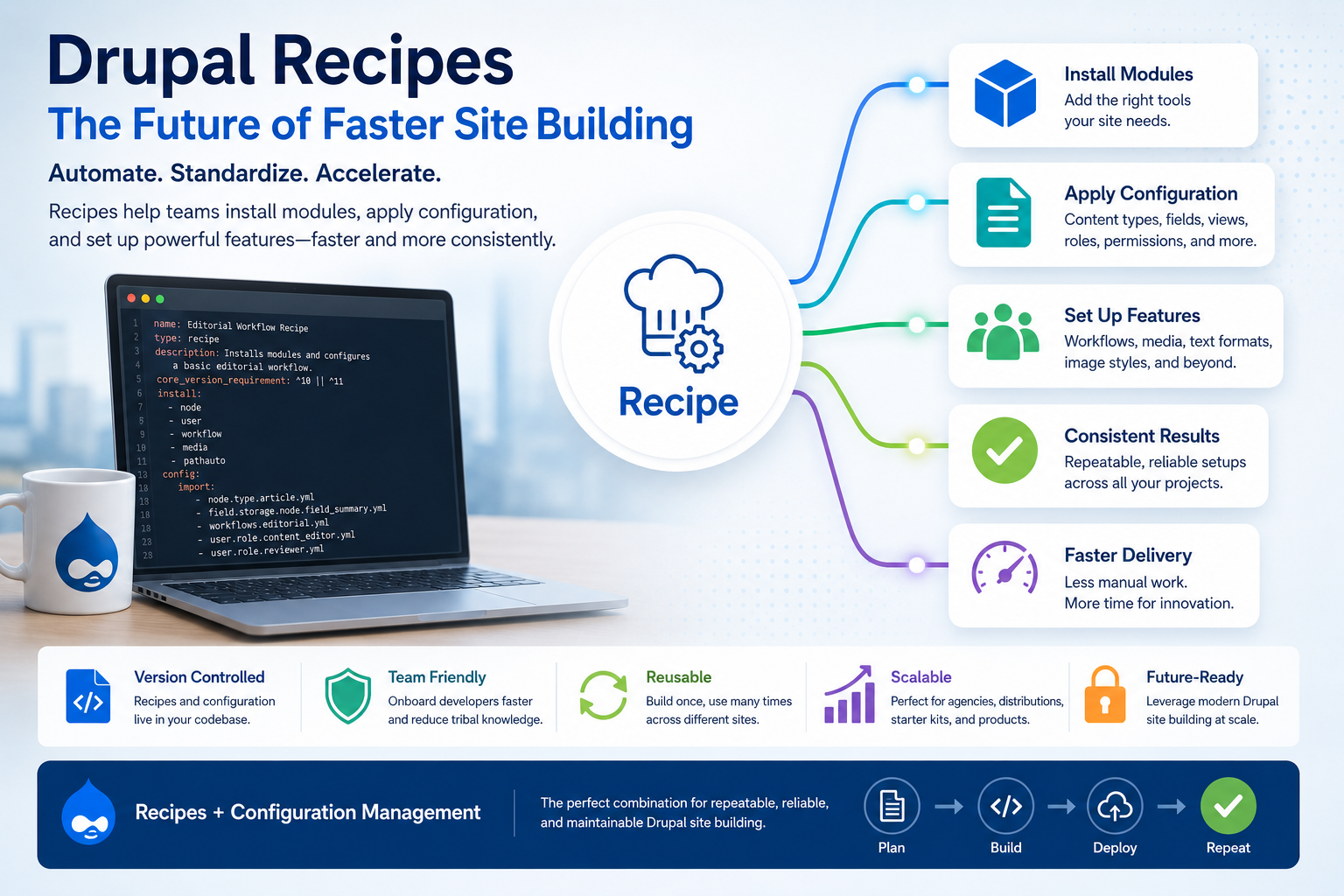
Drupal Recipes are one of the most interesting modern Drupal site-building improvements. They help automate repeatable setup tasks, such as installing modules, applying configuration, and preparing common site features.
If you have ever built several Drupal sites with similar content types, user roles, text formats, media settings, or editorial workflows, you can probably see the benefit right away. A Recipe can help package those repeatable decisions so they can be applied more consistently.
In plain English: Recipes are a way to make Drupal site setup faster, more repeatable, and less dependent on someone remembering every manual configuration step.
Why Recipes Matter
Drupal is extremely flexible, but that flexibility can also mean a lot of setup. A new site may need modules enabled, content types created, fields configured, image styles added, roles adjusted, permissions assigned, text formats configured, views created, and editorial workflows prepared.
When those steps are done manually, it is easy to miss something. It is also hard to repeat the exact same setup across multiple projects.
Recipes help solve that problem by turning common setup patterns into reusable instructions.
What Can a Drupal Recipe Do?
A Recipe can help automate common site-building work, such as:
- Installing modules needed for a feature.
- Applying configuration for content types, fields, roles, views, or other site-building pieces.
- Setting up common editorial or content-management patterns.
- Helping agencies reuse proven setup patterns across multiple builds.
- Reducing the amount of manual configuration needed after a site is installed.
Recipes are not meant to replace thoughtful site architecture. They are meant to make repeatable architecture easier to apply.
Recipes Compared to Traditional Drupal Setup
Traditionally, a Drupal developer or site builder might start a project, install modules, configure features, export configuration, and then repeat some version of that process on the next project.
That approach works, but it can be time consuming and inconsistent. If two sites need similar functionality, each site still requires someone to repeat the same configuration decisions.
Recipes create a cleaner path for repeatable features. Instead of relying only on memory, documentation, or copy-and-paste configuration work, a team can apply a Recipe that performs the setup steps in a predictable way.
Recipes and Configuration Management
Recipes are closely related to one of Drupal’s biggest developer wins: configuration management. Drupal configuration can already be exported, reviewed, committed to version control, and deployed between environments.
Recipes build on that idea by helping teams apply useful configuration patterns to a site. This can be especially valuable for agencies, productized website builds, demo sites, distributions, starter kits, and organizations that create similar Drupal sites more than once.
For example, a team could create a Recipe for a basic editorial workflow, a media setup, a landing page pattern, a privacy-focused user setup, or another repeatable feature.
Why Recipes Are Useful for Agencies and Developers
Recipes are especially useful when a team has learned from multiple projects and wants to reuse those lessons. Instead of starting from scratch every time, a team can package common best practices into repeatable setup steps.
This can help reduce project setup time, improve consistency, and make it easier to maintain a standard approach across builds.
Recipes can also make onboarding easier. A new developer or site builder can apply a Recipe and review the resulting configuration instead of manually recreating the whole setup from scattered notes.
Recipes Are Not Magic
Recipes are powerful, but they do not eliminate the need for planning. A site still needs the right content model, accessibility strategy, design system, editorial workflow, permissions model, hosting plan, and maintenance process.
A Recipe can help apply known patterns faster. It cannot decide what your organization needs, whether your content model is clean, or whether your site is accessible and maintainable.
That is why Recipes are best viewed as automation for repeatable site-building work, not a replacement for good discovery and architecture.
Conclusion
Drupal Recipes are a major step toward faster and more repeatable Drupal site building. They can install modules, apply configuration, and help teams reuse proven setup patterns across projects.
For developers, agencies, and organizations that build or maintain multiple Drupal sites, Recipes can reduce repetitive work and make site setup more consistent. For site owners, that can mean faster builds, fewer missed setup steps, and a stronger foundation for long-term maintenance.